

Collate Meaning: What Is It, Definition, and Usage
When pages, records, or data appear in the wrong order, it can be difficult to use them. To collate means to collect items and arrange them in a particular sequence. This article explains the Collate Meaning and shows how to use it clearly.
What Does Collate Exactly Mean?
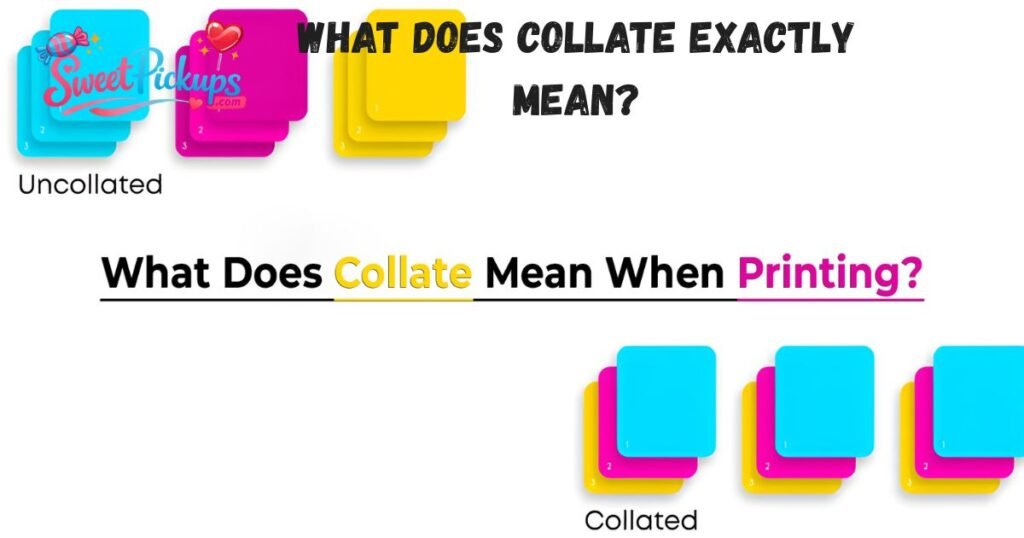
To collate means to collect items and arrange them in a particular order. The word applies when simply gathering things is not enough: the items also need to be organized so their sequence is clear.
For example, collating a set means checking that each group is complete and that its parts appear in the correct order. That distinction matters whenever someone asks you to collate documents, pages, or other materials—the goal is an orderly, complete set, not just a pile of items.
What does Collate Meaning in Dictonary?

In standard English dictionaries, **collate** is a verb meaning to gather and arrange written material in a particular order. For example, a person might collate notes or documents so they can be reviewed as a clear sequence.
The word also describes assembling pages into complete sets, such as putting printed pages in the correct order for each copy of a document. In another use, to collate is to compare different versions of a text and identify how they vary.
Origin and History of the Word “Collate”
The word “collate” comes from the Latin term *collatus*, meaning “to bring together.” Its origin reflects the central idea behind the word: assembling separate items so they can be considered side by side.
In academic and religious work, scholars collated manuscripts by gathering different versions of a text and carefully comparing them. Bringing the versions together helped scholars examine how they differed and what they shared. This historical practice gives “collate” its lasting sense of collecting and arranging material for comparison.
How the Word Collate Is Used in Real Life?
Collation is the act of gathering and arranging items into a useful order. You may do it without using the word: putting the pages of a report in sequence, grouping documents for a meeting, or sorting papers into sets. In each case, separate pieces are brought together according to a plan.
The term also appears in fields such as printing, publishing, and information management, where arranging pages, records, or other materials correctly helps make them easier to use. Details vary by setting, but the core idea remains the same: collect the right items and place them in the intended order.
How can the word collate be used in a sentence?
Use **collate** when you mean to compare information or gather and arrange documents. For example: “Before submitting the report, Maya collated the figures from both spreadsheets to check that they matched.” Here, the word describes bringing information together for comparison.
It can also refer to putting printed pages in the right order: “After printing the handouts, Luis collated the pages into complete sets.” In either case, **collate** suggests organizing separate items into a useful whole.
What is the origin of the word collate?
The word *collate* has been used since the 1610s to mean bringing things together and comparing them, as well as examining them critically. Its roots point to that central idea of gathering material for careful review.
*Collate* comes from the Latin *collatus*, the irregular past participle of *conferre*, meaning “to bring together.” The word’s history connects its sense of comparison and examination to the act of assembling things side by side.
When is it useful to collate?
Collation is useful when you’re printing multiple copies of a document with several pages that need to stay in order. Instead of printing every copy of page one, then every copy of page two, a collated print job produces complete sets—for example, pages 1–4 followed by another set of pages 1–4.
This is especially helpful for handouts, reports, or manuals that will be distributed as separate copies. If the pages don’t need to remain in sequence, or you plan to assemble each set yourself, collation may not be necessary.
Why Collation Is Important
Collation keeps printed pages in the correct order and groups them into complete sets. When you print multiple copies of a multi-page document, each set comes off the printer ready to read—for example, pages 1 through 5 together, followed by the next complete set.
For bulk printing, this can save the time and effort of sorting loose pages by hand. It also makes it easier to prepare documents for distribution, binding, or other finishing steps. Before printing, check the collation setting to make sure it matches how you want each copy assembled.
You may also read: 100+ Best Scary Riddles For Kids & Adults: Catchy, Cool & Unique Ideas
Conclusion
To collate is to gather and arrange items into an organized set—such as putting document pages in the correct order. When you see the word, use the surrounding context to tell what is being collected and how it should be arranged. Next time you encounter it, check the instructions before sorting or assembling anything.
FAQs
What does collate mean?
Collate means to collect, arrange, and organize information, documents, or items in a specific order.
What does collate mean in simple words?
In simple words, collate means to gather different things together and put them in an organized order.
What does collate mean in printing?
In printing, collate means arranging printed pages into the correct sequence so that each complete copy is properly organized.